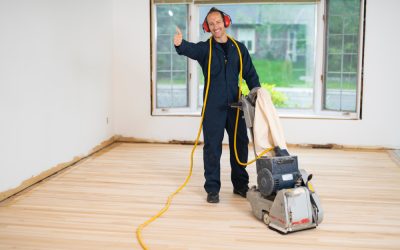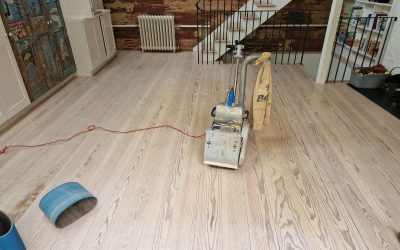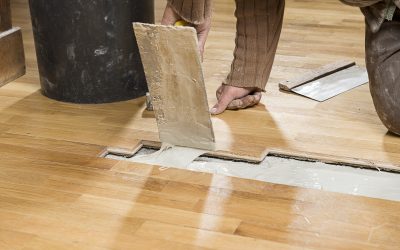
Weekend Commercial Floor Sanding in West Brompton, SW10
Commercial timber floors around West Brompton, SW10 take considerably more punishment than a domestic floor. Restaurants off Old Brompton Road, schools and institutional buildings, church halls, offices and busy commercial premises can develop worn lacquer, ingrained traffic lanes, blackened board joints and dangerously polished areas long before the timber itself has reached the end of its working life.
Our weekend commercial floor sanding in West Brompton is organised around the building rather than expecting the building to work around us. Where a premises cannot be closed during the week, we can phase sanding, repairs and finishing through Friday evenings, Saturdays, Sundays and agreed out-of-hours periods so that disruption is controlled and the correct curing window is maintained.
We undertake Commercial Floor Restoration in West Brompton, planned Commercial Floor Maintenance in West Brompton and specialist Commercial Floor Polishing in West Brompton for timber floors ranging from quartersawn oak and traditional pitch pine to teak, maple and older parquet installations.
West Brompton sits among a substantial stock of Victorian and later period property, with Old Brompton Road, Fulham Road, Brompton Cemetery and the neighbouring Earl’s Court conservation areas all contributing to the local building character. Nearby conservation areas contain Victorian terraces, mansion blocks, stock-brick buildings and Italianate detailing dating largely from the later nineteenth century, so we regularly approach these floors as retained building fabric rather than disposable surface finishes.
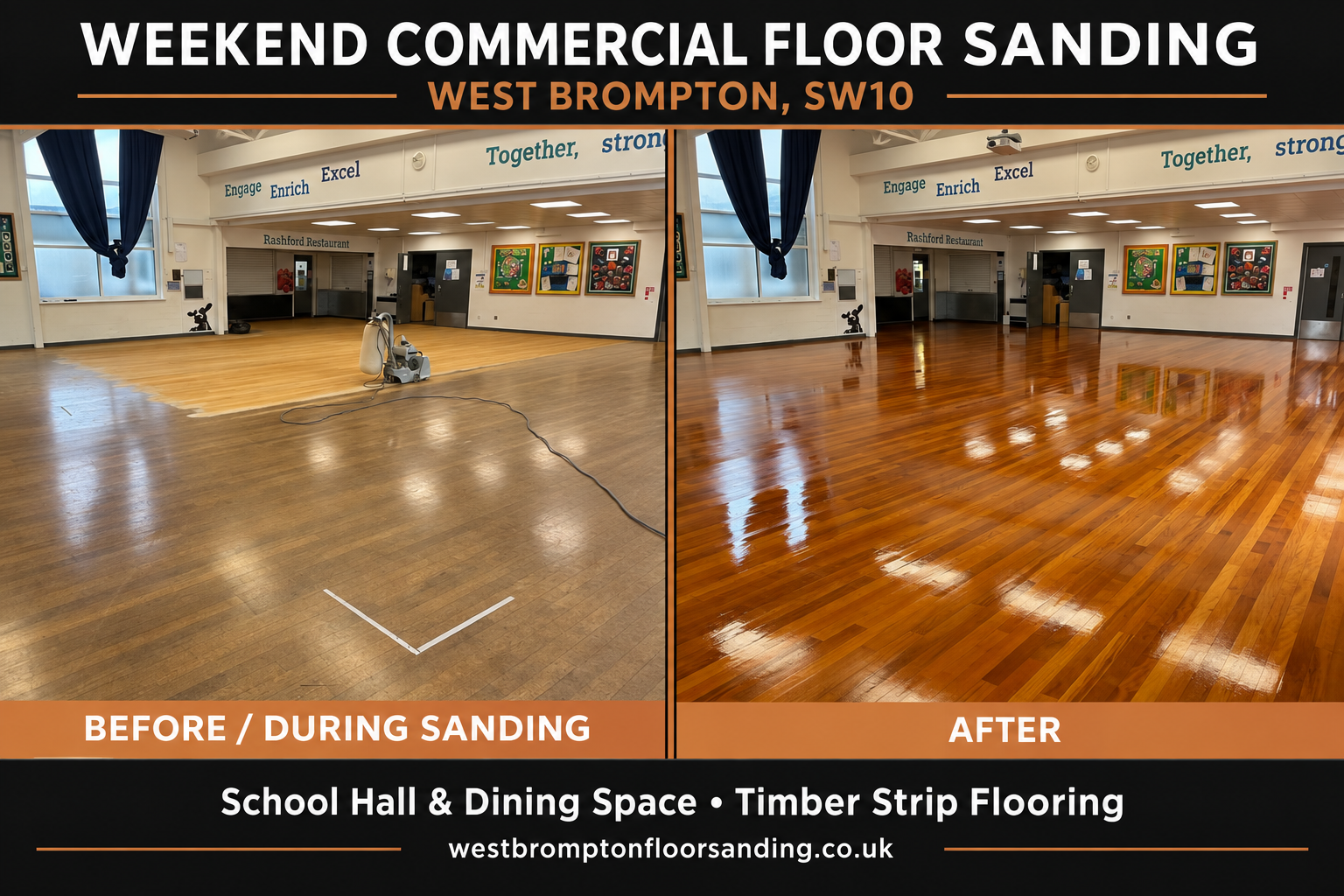
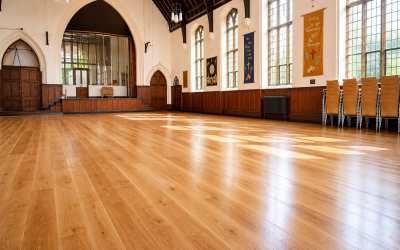
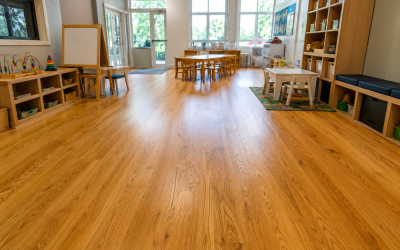
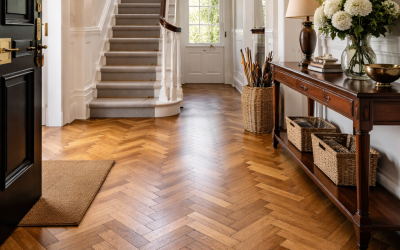
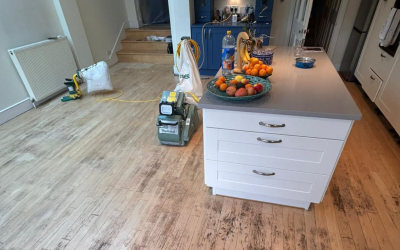
Before and after commercial timber floor restoration in a school hall and dining space in West Brompton, SW10.
Commercial Timber Floors in West Brompton Need More Than Domestic Sanding
A restaurant floor carrying chairs, grit and cleaning chemicals every day behaves differently from oak boards in a spare bedroom. The same applies to school halls, reception areas, churches and communal corridors where concentrated traffic gradually wears through the finish and starts abrading the exposed timber underneath.
Applying an off-the-shelf polish over that damage normally disguises it temporarily rather than correcting it. Polish can also create adhesion problems when the floor eventually requires recoating, particularly where silicone-containing cleaners, waxes or incompatible acrylic products have been used repeatedly.
Before specifying a process, we establish the timber species, previous coating, board condition, fixing method and expected traffic. A Victorian pitch-pine floor on suspended joists requires a different repair strategy from bonded oak parquet over a modern screed.
- Open joints and failed gaps: dirt, food debris and cleaning moisture collect between boards and parquet blocks.
- Loose parquet: failed bitumen or adhesive can allow blocks to move, drum or break under point loading.
- Moisture movement: elevated subfloor moisture can cause cupping, adhesive failure and premature coating breakdown.
- Slip risk: worn, contaminated or incorrectly polished surfaces can produce inconsistent traction across pedestrian routes.
- Uneven wear: entrances, serving areas, corridors and chair zones often require more controlled cutting than protected areas.
- Over-sanding: aggressive domestic-style sanding can unnecessarily reduce the remaining wear layer on engineered timber or historic boards.
- Incorrect coatings: a soft domestic lacquer may look satisfactory initially but deteriorate rapidly under commercial traffic.
Our Step-by-Step Commercial Floor Restoration Process
Step 1: Subfloor Audit & Moisture Testing
We do not start a commercial sanding job by simply unloading a belt sander. The first stage is checking how the floor is constructed, identifying loose areas, looking for previous repairs and establishing whether there is any evidence of moisture movement.
Where conditions justify it, hygrometer readings are taken to assess the subfloor environment before bonded repairs or finishing systems are specified. Sanding and sealing timber while abnormal moisture is present can lock a problem beneath an expensive new finish.
We also identify the species wherever reasonably possible. Quartersawn oak, pitch pine, teak and maple respond differently to abrasive cutting, fillers, oils and waterborne coatings, while engineered boards have a limited usable wear layer that must be respected.
Step 2: Timber Repairs, Re-Bonding & Resin Gap-Filling
Loose parquet blocks are lifted carefully where necessary, old unstable residues are prepared and the timber is re-bonded with an appropriate flooring adhesive. On suitable substrates we favour modern flexible silane-based parquet adhesives because they accommodate controlled timber movement without the brittle characteristics associated with some older adhesive systems.
Damaged boards can be locally replaced using matching reclaimed or compatible timber where available. We pay attention to width, thickness, grain and species rather than dropping conspicuously different softwood into an otherwise sound period oak or pitch-pine floor.
For stable fine gaps, a resin-slurry filler mixed with clean sanding dust can produce a far more convincing result than squeezing generic decorator’s filler between boards. Large movement gaps or unstable suspended boards need to be dealt with according to their construction rather than rigidly filled and expected never to move again.
Step 3: HEPA Dust-Controlled Sanding & Surface Preparation
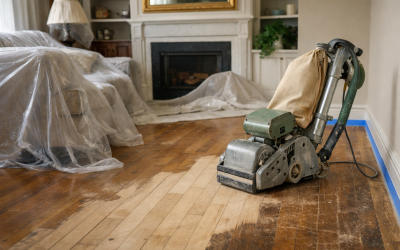
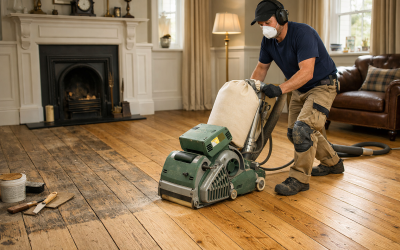
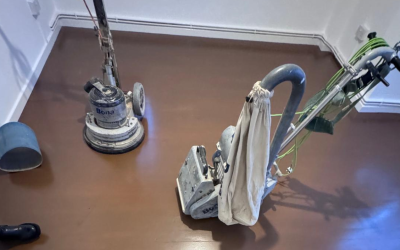
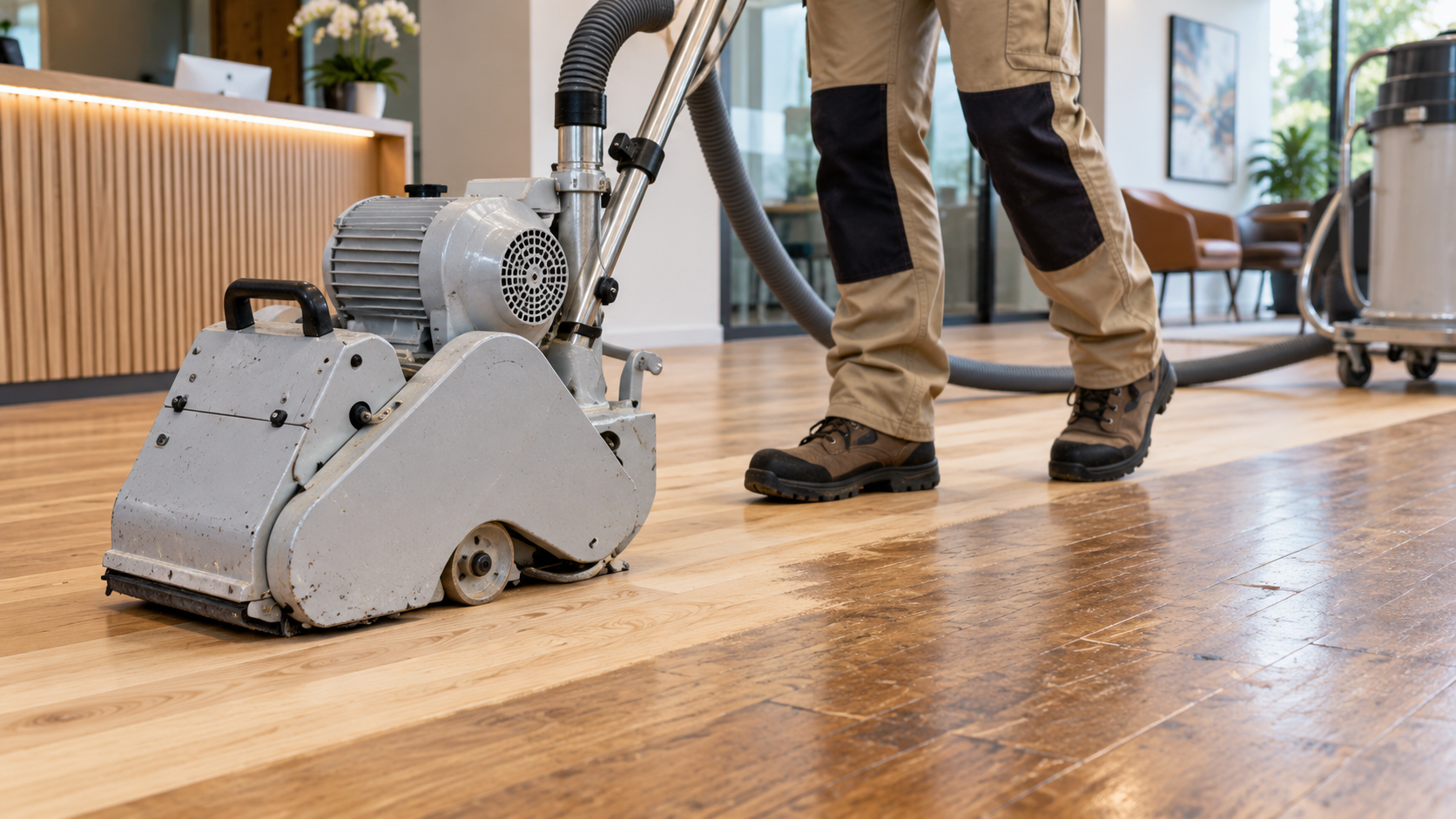
Our principal floor reduction is carried out with professional belt sanding equipment such as the Lägler Hummel connected to high-efficiency extraction. Where site conditions require enhanced dust management, the extraction arrangement is specified around HEPA H14 filtration and controlled hose connections rather than relying on the small disposable bag fitted to a basic sanding machine.
A heavily damaged commercial floor may begin around 36 or 40 grit, followed by intermediate cuts and finishing through approximately 80 to 120 grit depending on timber species and the coating being applied. We do not automatically start aggressively; abrasive selection is based on coating thickness, floor flatness and how much timber genuinely needs to be removed.
Edges, radiator zones, thresholds and corners are prepared separately so the final surface is visually consistent. Before coating, the floor is thoroughly vacuumed and inspected because sanding marks, filler residue or contamination become considerably more obvious after lacquer is applied.
You can see examples of the type of restoration and sanding work we undertake on our floor sanding gallery.
Step 4: High-Traffic Finishes – 2K Lacquers, Hardwax Oils & Anti-Slip Systems
The coating specification is based on the building’s use rather than whichever tin happens to be available. For heavily trafficked commercial floors we commonly consider professional two-component waterborne polyurethane lacquers in which the hardener or cross-linking catalyst reacts with the main coating to create a tougher cured film.
Products such as Bona Traffic HD, LOBA 2K systems or comparable professional finishes may be considered where their technical specification suits the floor. Hardwax oils can be appropriate for certain oak and heritage floors where localised maintenance is important, but an oil specification should not be chosen merely because it appears traditional.
For adhesives, primers and associated installation materials in occupied interiors, low-emission products carrying recognised classifications such as EMICODE EC1 Plus can be specified where appropriate. EC1 Plus is the highest EMICODE low-emission class and is particularly relevant when working in schools, offices and other occupied buildings where indoor-air emissions need consideration.
Slip resistance also needs to reflect the conditions in which the completed floor will actually operate. Pendulum testing under the established BS 7976 methodology remains widely recognised in the UK, while BS EN 16165:2021 now provides the current European-standard framework; any specified result needs to be interpreted alongside contamination, cleaning regime and the actual end-use environment.
Step 5: Aftercare & Commercial Maintenance Protocols
The floor is not finished simply because the last coat has been rolled. The first hours and days after coating have a direct bearing on appearance, durability and whether the surface develops early marking.
Initial light foot traffic may be possible once the selected coating has reached the manufacturer’s stated stage of cure, but furniture loading, chair dragging, mat replacement and wet cleaning can require longer. Two-component finishes may become touch-dry comparatively quickly while continuing to cross-link chemically for several days.
We therefore issue practical handover guidance covering reopening times, furniture placement, entrance matting and the cleaning products suitable for the installed finish. For busy commercial premises, planned maintenance and periodic recoating are normally considerably cheaper than allowing traffic to wear completely through the protective film and into the timber.
For budgeting before a survey, visit our commercial floor sanding prices page. Final commercial quotations are based on the actual floor condition, access, repair requirement, finish specification and working hours rather than area alone.
Weekend and Out-of-Hours Floor Sanding in West Brompton
Commercial sanding in SW10 often succeeds or fails on logistics. Noise restrictions, neighbouring residents, alarms, loading access, furniture movements, security arrangements and coating cure times all need to be agreed before the first machine reaches site.
For restaurants and shops, we may work after the final service and prepare sections ready for coating before the next trading period. Schools, churches and halls can often be programmed through weekends or closure periods, while larger premises can be divided into independently usable sections.
| Working Shift | Operational Benefit | Typical Facility Suitability |
|---|---|---|
| Overnight | Allows preparation or sanding after normal operating hours while keeping key areas available during the day. | Restaurants, offices, shops, receptions and selected hospitality spaces. |
| Weekend Phased | Creates a longer uninterrupted window for sanding, coating and controlled initial cure. | Schools, offices, clinics, churches, community buildings and commercial halls. |
| Sectional | Keeps part of a larger facility operational while isolated sections are restored in sequence. | Large halls, corridors, multi-room premises and continuously occupied buildings. |
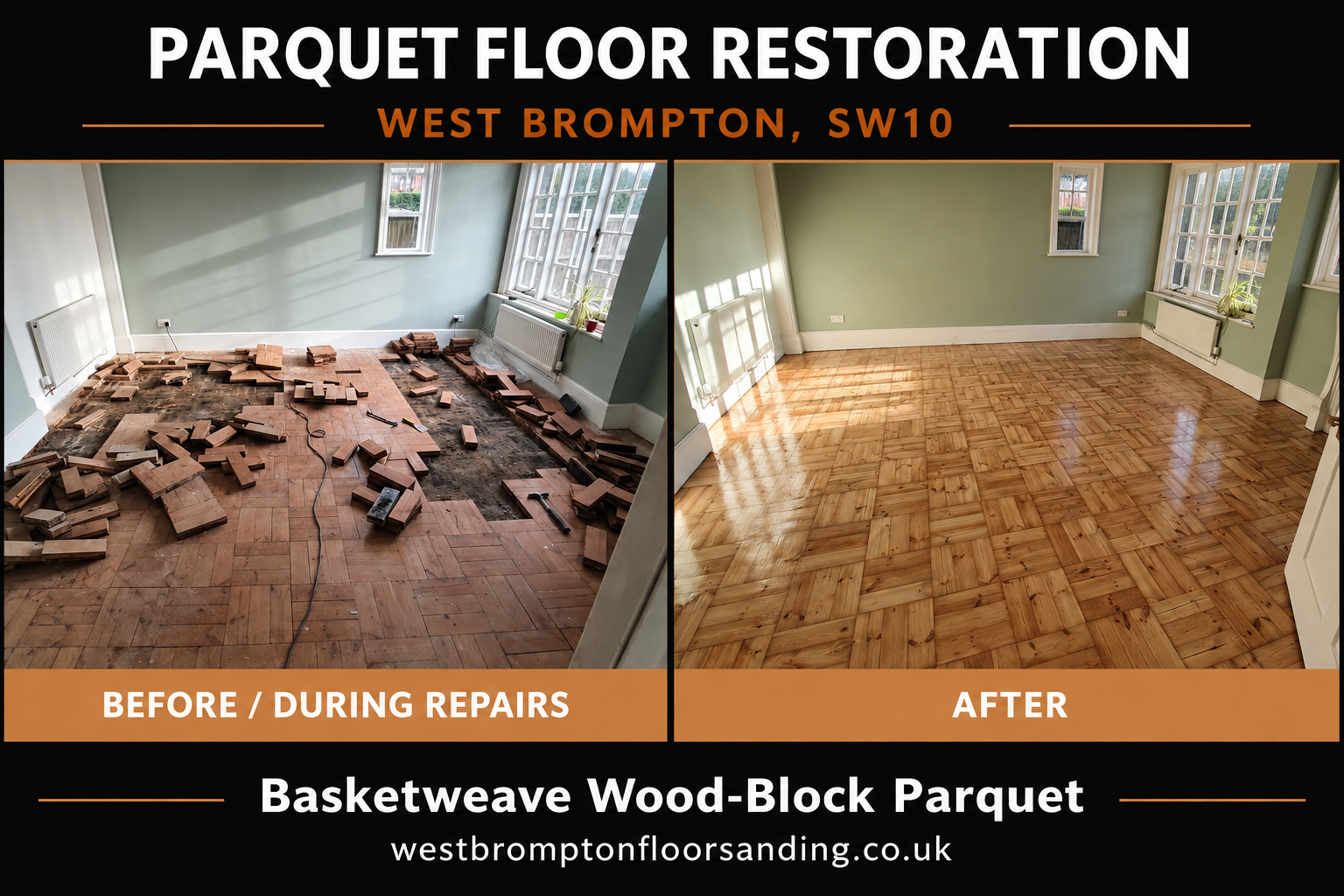
Before-and-after parquet restoration featured by West Brompton Floor Sanding, showing block repairs and the finished floor.
Commercial Health & Safety Is Part of the Job
Before site work, commercial projects can be supported by RAMS documentation covering the agreed sanding, extraction, coating and access arrangements. COSHH information is considered for fillers, adhesives, cleaners and finishing products, with ventilation and exclusion periods incorporated into the working method where required.
Machines, extraction hoses and power cables are positioned to reduce trip exposure and prevent uncontrolled access to the work zone. Where the premises remain partly occupied, barriers, phased access and clear handover points become just as important as the sanding itself.
Where a project has a formal slip-resistance requirement, this should be specified and tested using an appropriate recognised method rather than relying on descriptions such as “non-slip lacquer”. The HSE identifies pendulum testing as the preferred way of properly assessing floor slip resistance, with the finished surface considered under realistic service conditions.
West Brompton Commercial Floor Specialists You Can Plan a Project With
We work with property managers, facilities teams, schools, churches, hospitality operators, landlords, contractors and commercial occupiers who need a practical programme rather than a vague promise to “sand the floor”. The quotation should state what preparation is included, the proposed coating system, repair allowances and any operational assumptions affecting the job.
Our commercial teams can include CSCS-carded operatives where site requirements call for them, backed by appropriate commercial liability insurance and site-specific working documentation. Before confirming substantial works, we normally want enough information to understand floor area, condition, access, power, existing finish and intended use.
A useful first assessment can often be made from clear photographs, a short walkthrough video and a basic floor plan. For larger, technically uncertain or heavily repaired floors, we recommend a physical site survey before final specification and scheduling.

Arrange a West Brompton Commercial Floor Survey
If your timber floor in West Brompton, SW10 needs to be restored without taking the premises unnecessarily out of service, call 0800 335 7565.
You can also send photographs, a short video and any available floor plans by WhatsApp or email. We can use those to establish the likely scope before arranging a physical survey where required.
Weekend, overnight and phased commercial programmes can be planned around your normal operating hours.